Salt in Sourdough Bread: The Comprehensive Guide
When people think about sourdough bread recipes, they usually focus on the starter. Yes, the sourdough starter is undoubtedly the defining feature of sourdough bread, but it’s not the only important ingredient. In this post we are doing a deep dive into salt in sourdough bread.
Why Should I Care About Salt?
If you follow along on my social media channels, you know I love performing A/B tests with my sourdough bread recipes. I love getting into the nitty gritty details about sourdough bread and using science to see what actually works.
If you’ve been in the sourdough space for any length of time, you know that there are a million and one ways of baking sourdough. It can be quite overwhelming when everyone is telling you their way is the right way. That’s exactly why I started running these experiments.
I too am one of those voices that teaches you sourdough. BUT, I want to make sure I am a voice that is helpful and teaching you how to bake sourdough based on science and tested experience. And just to give you a little glimpse into my background, I am a registered dietitian and I also minored in chemistry. So, learning the science and chemistry of bread is right up my alley.
Recently, I started experimenting with salt and how it affects sourdough bread. I dove deep into the science of salt to see how this lesser ingredient affects bread. Believe it or not, salt is one of the most powerful, yet overlooked ingredients in your dough. A difference of even a few grams can completely change:
- fermentation speed
- dough strength
- gluten development
- flavor
- crumb structure
- and overall handling
Let’s break down exactly what salt is doing in sourdough bread — from the science of gluten all the way down to microbial activity. (P.S. if your newer to sourdough, check out my beginner sourdough bread recipe and my guide to maintaining a healthy sourdough starter)
The Standard Salt Percentage in Sourdough
First let’s talk about salt percentages. There are actually standard percentages used in bread baking that are commonly accepted by the most reputable and experienced bakers. Most sourdough recipes use salt at about:
1.8% – 2.2% of salt relative to flour weight.
That means if your recipe contains 500g flour, you’ll usually see somewhere around:
500g x 0.02 = 10g salt
Around 2% has become the “sweet spot” for most artisan sourdough because it balances flavor, gluten strength, extensibility of the dough and fermentation speed. If you don’t balance salt in your recipe, you can run into some problems with your final loaf of bread.
As an example, too little salt and the dough can ferment too quickly, become sticky, weak, and overly acidic. Too much salt slows fermentation dramatically while the dough can become overly tight and difficult to expand.
What Salt Actually Does in Dough
Like we already mentioned, salt does far more than make bread taste good. It has very important chemical effects on gluten and on yeast.
At a scientific level, salt affects:
- gluten proteins
- enzyme activity
- water movement
- and microbial fermentation
Salt Strengthens Gluten
To understand how slat affects gluten, we need to understand what gluten is and how it is formed.
Flour contains two primary proteins- gluten and gliadin. When hydrated and mixed, these proteins bond together to form gluten. Gluten is what gives bread its strength and allows even high hydration doughs to form tall, well-formed loaves of bread.
Salt helps tighten and organize this gluten network by influencing the electrical charges on the proteins. Without getting too deep into chemistry, gluten proteins naturally repel each other in some areas because of their ionic charges.
Salt helps reduce that repulsion and allows gluten strands to come together and elongate. The result?
- stronger dough
- improved elasticity
- better gas retention
- more structure during fermentation
If you fail to add any salt to your dough, it will be slacker, stickier, harder to shape, and more prone to spreading.
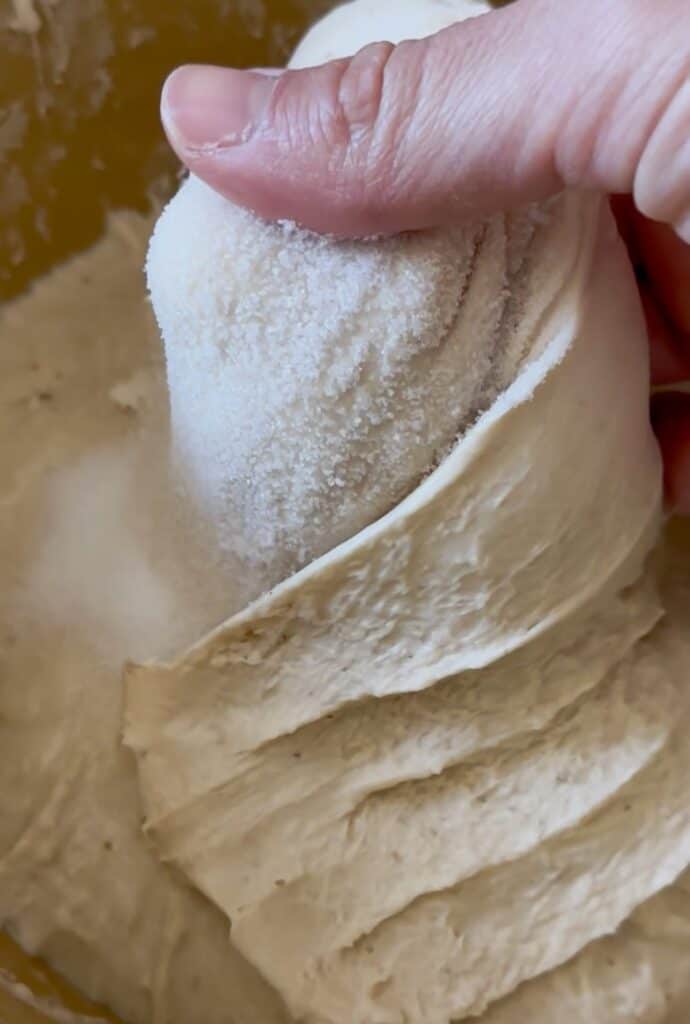
Salt is so powerful, you can actually feel the dough strengthen shortly after adding salt. If you want to see this effect in action, try adding your salt during your second stretch and fold. You will immediately feel how tough and tight the dough feels once you add it.
Salt Slows Fermentation
So after learning about how much strength salt adds to your dough, you’re probably thinking, “the more salt the better!”. Not exactly. While salt strengthens gluten, it also inhibits yeast growth and fermentation of the lactic acid bacteria. Why?
Because salt affects osmotic pressure.
Essentially, salt pulls water away from microorganisms (i.e. yeast and lactic acid bacteria). Like all life, water is essential. When salt hogs the water, it makes it harder for yeast and bacteria to reproduce and metabolize efficiently.
What you will actually see in dough that has a higher percentage of salt is that the dough ferments more slowly. This allows more time for the gluten network to develop without excess acid formation. This is important because too much acid weakens the dough strength.
As you can see, this slowing effect is not a bad thing. The slower controlled fermentation gives sourdough better flavor, stronger structure, and improved oven spring.
Without enough salt, fermentation can become overly aggressive and the dough may overproof before the gluten network is strong enough to support expansion.
Autolyse vs Fermentolyse
Before we talk about the timing of salt addition in sourdough, we need to talk a bit about some terminology. Autolyse and fermentolyse are both methods of delaying salt in sourdough, but they are not the same thing.
Autolyse
The word “autolyse” literally means self (auto-) splitting (lyse). The definition of autolyse when referring to a cell is “to be destroyed by its own enzymes”.
A true autolyse is a process in which the flour and water are mixed in a dough. The dough is then allowed to rest. The rest time varies but is often 30 minutes to 1 hour in length. After this period, salt and the sourdough starter is added to the recipe.
The dough rests before mixing to allow hydration of the flour, increased enzymatic activity (especially amylase), and passive gluten formation. This can improve extensibility and reduce mixing time.
Fermentolyse
A fermentolyse is a newer term used in baking that was coined from word autolyse. It is similar to an autolyse but includes the addition of starter to the flour and water. The only ingredient left out is the salt.
Because starter is present, fermentation begins immediately during the resting period. The primary purpose of leaving out the salt in a fermentolyse is to allow a head start on fermentation by delaying adding salt.
Why Some Bakers Delay Adding Salt
The main reason bakers delay salt is because removing salt temporarily allows fermentation to accelerate. Essentially, delaying adding the salt is fermentolysing the dough.
Without salt:
- yeast reproduces faster
- bacteria become more active
- enzymatic activity increases
- and gluten develops with less tightening initially
In theory, this can improve extensibility, slightly accelerate bulk fermentation and help achieve a more open crumb in some doughs. But in practice, the differences are often much smaller than social media makes them seem. How do I know? I’ve tested it.
My Take After Testing Salt Timing
After running side-by-side experiments with salt timing, I personally don’t think delaying salt is necessary for most standard sourdough recipes. Here’s why.
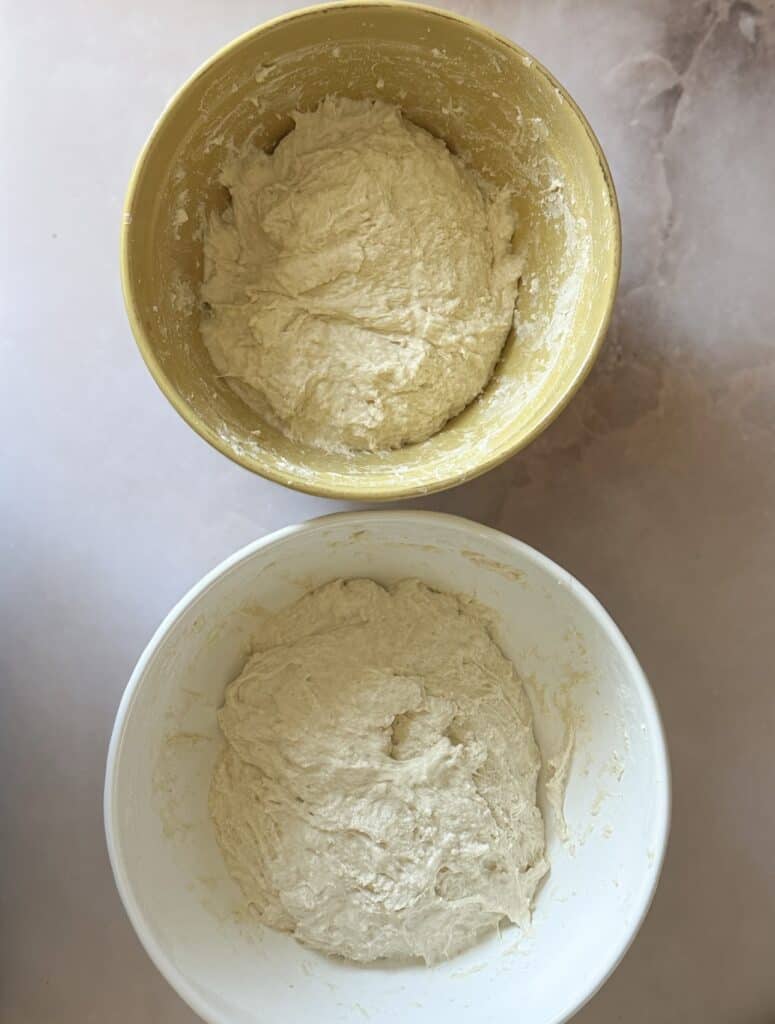
I made two otherwise identical loaves at the same time with the exact same ingredients and measurements. I used the same number of stretch and folds and fermented them for the exact same amount of time. The only difference was that I added salt at the beginning in one loaf (left), and waited an hour to add the salt in the other loaf (right).

Loaf 1: Salt Added Immediately
If you look closely at the photo above, you can see some slight differences. The crumb for the loaf with the salt added immediately looks a bit more dense. This loaf also has a more prominent triangle shape and large holes at the top of the bread. These signs indicate that it is a bit under proofed.
Loaf 2: Salt Added After 1 Hour Fermentolyse
In contrast, the loaf on the right had salt addition delayed until after a 1 hour fermentolyse. As you can see, the crumb appears more open, there is less of a triangle shape, and there are fewer large holes at the top. I think this loaf is still slightly under proofed but not nearly as much as the other loaf.
Salt Experiment Summary
I actually did this experiment TWICE because I wanted to make sure I got similar results before making any conclusions. In both tests, the loaf with salt added later fermented faster. There were noticeable differences indicating that the loaves were fermenting at different rates. Based on what we learned about how salt affects fermentation speed and yeast proliferation, this makes sense.
In a real life experiment, delaying salt addition made the bread ferment faster. Otherwise, I didn’t really see any dramatic differences between the loaves. Both loaves tasted good, the first loaf just needed to be proofed a little longer and I think it would have had a comparable crumb to the second loaf.
How Do We Apply The Results?
Yes — delaying salt absolutely increases the rate of fermentation early on.
And yes — you can see earlier yeast proliferation when salt is withheld initially.
But for a typical sourdough loaf, I haven’t found the end result significant enough to justify complicating the process. Plus, you run the risk of forgetting to add the salt to your recipe if you delay adding it until later.
For everyday sourdough baking, I think simplicity and consistency matter more than chasing tiny theoretical advantages. That being said, there are a few situations where I think delaying salt can be beneficial.
When Delaying Salt Can Be Helpful
Where I do think delayed salt addition can make sense is in doughs containing ingredients that naturally suppress yeast activity.
Things like:
- lemon
- cocoa
- chocolate
- pickles
- high acidity ingredients
- or certain enriched dough components
These ingredients can create a more challenging environment for yeast.
Allowing fermentation to get established before introducing salt can sometimes help “kick start” microbial activity and improve overall fermentation strength.
In those cases, a short fermentolyse before adding salt may actually be useful.
Salt Tips Based on Flour Type
Playing around with your salt percentages can also be very helpful depending on the type of flour you use.
All Purpose Flour
Many bakers use all purpose flour for their sourdough bread. This type of flour is generally lower in protein and therefore doesn’t have as much building blocks of gluten. Because salt adds strength to gluten, it can be beneficial to increase the salt slightly when you are using a flour with a lower protein content. The tradeoff here is that salt inhibits yeast and therefore this could affect the overall rise and rate of fermentation of your dough. This type of flour can also benefit from delaying adding your salt until after a 1 hour fermentolyse, which gives the yeast a jumpstart on fermentation.
Bread Flour
Bread flour has a high amount of protein which ultimately leads to better gluten formation. Loaves made with bread flour don’t need the strengthening effect of salt as much. With this type of flour, you can get away with using a lower percentage of salt. This will still preserve gluten strength, but will also give yeast that added boost.
Final Thoughts
Salt is the smallest ingredients in sourdough by weight, but it has a hugely important job in the final loaf of bread.
It controls:
- fermentation speed
- dough strength
- flavor development
- and overall dough behavior
While many people have strong opinions about salt, I think understanding the science behind it matters most when making decisions about how to use it in your recipe.
I hope you found this article helpful. If you love learning about the science of sourdough, join our community on Instagram and Facebook or sign up for my email list. We frequently discuss topics in sourdough baking to help you bake better bread, using science.